
Nomonde 's Story
In the 11th century a massive migration took place across the continent as a result people from South Zaire moved to different directions and settled in most parts of Southern Sahara. Among the tribes that took part in this major migration was Xhosa tribe. Xhosa tribe settled and became a part of the larger tribe in South Africa. Xhosas are the second largest tribe in South Africa after Zulu tribe.
Xhosa is a descendent of the Nguni clan. The word Xhosa is from a legendary leader known as u Xhosa. Another theory claims that word Xhosa is derived from San tribe or Khoi-Khoi language. The language of Xhosa has 15 clicks borrowed from the current extinct Khoi Khoi and the San language (Bushman)
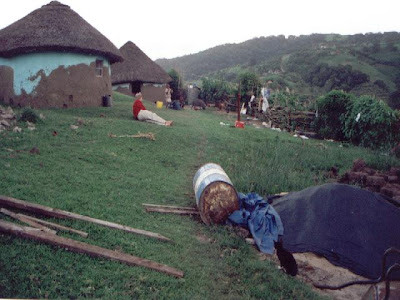
Xhosas settled in the Eastern Cape of South Africa, this is where I was born in a very small town called Ngcobo at a location called Mbhekeni. As a little girl I remember not having any clothes but a blanket with a big safety pin underneath all I had was beads on my waits covering my bits no wonder I still feel the cold. I was a very smart child because I used follow my mother to the fields by following her footprints tracing them from our house how many kids would think or my mother is gone let me trace her foot prints and the next thing she hears this little voice saying I found you mommy thank God there were no paedophiles in my village.
Village life was nice but it was not easy although I am grateful now as I am putting all those lessons to practice. We had to fetch water from the river multiple times a day developed a skill of carrying the water on our heads in a 25 litre bucket with very strong necks as we did not even hold it. We also travelled for hours to go to the forest to collect firewood and this was a must as it was the only option to cook apart from dry cows’ dung. We were self-sufficient this meant once summer rains come, we had to plough fields and plant crops that was corn and vegetables.
I remember when I nearly had a terrible accident because we used oxen to plough and plant, to plant you would have 2 oxen one person behind them holding a plough or planter then on person in the front guiding them to create a straight line to plant, one of them was having a bad day that day his name was Moskina, he picked me up with his horns and threw me out of his way this was my way out of a most hated job by me. From there onwards I refused to work with cattle.
Throughout schooling we had no shoes this was normal for all of us, walking everywhere without shoes this was a norm for us but winter was bad, crunching frost with our bear feet walking 20ks per day to school. I told myself that one day when I work I will buy shoes loads of them, as a result the last time I checked I had more than 100 pairs of shoes true story. As teenagers we all had our dreams some wanted to be teachers, some Doctors some nurses mine was simple I wanted to travel I wanted to go overseas back in the day other children used to laugh and say now how do you think you are going to get there, I just believed that I could get there one day I did not know how but I had the dream.
My teenage life was cut short as I was in an arranged marriage with a complete stranger I ran away ended up in Cape Town it was tough in South Africa in those apartheid years as black people needed permits to find work in big cities as a result we were arrested that many times for trespassing but that did not deter us. here we were the Aboriginals of Africa ill-treated in our own country and yet any white person from overseas had the freedom to enjoy life in our country. I ended up in Johannesburg where I met the most wonderful couple the lady was very fussy my friends told me, they said she did not want to employ any staff. I decided to go and try my luck this lady welcomed me with open arms she gave me a job I worked for her as a maid for 11 years. Sadly, they did not like what was happening in South Africa and decided to create a better future for their children who were like my children too as I looked after them. They migrated to Australia; this was another blow for me here I was relying on these God sent Saints now they are leaving me. They left me in their business I started off as a clerk with few courses I ended up being a bookkeeper.
They promised me that one day when they settled, they would get me to visit them in Australia, far fetched I thought but there are people out there who are honest and love unconditionally these people had true love for me they fulfilled their promised they bought me a ticket to visit them in Australia. Hear I was preparing to fly overseas never been on a plane but now I was not flying to Cape Town or Durban but to Australia. Some people get lucky their dreams come true I was one of those lucky one my dream as a little girl came to pass.

In my travels to Australia I met a very nice and a very kind man an Australian man who married me, this enabled me to become a dual citizen of South Africa and Australia.
This gets to show that where there is a will there is a way and if you pray and trust the Lord he will answer your prayers.
yiza undwendwele
- Come Visit
XHOSA MEANING
The word “Xhosa” is derived from the Khoisan language and means “angry men”. Most of the languages in South Africa that involve tongue-clicking originate from the indigenous Khoisan people, who included plenty of different clicks in their speech and language Rituals
XHOSA FOOD
Traditional diet
The Xhosa settled on mountain slopes of the Amatola and the Winterberg Mountains. Many streams drain into great rivers of this Xhosa territory, including the Kei and Fish Rivers. Rich soils and plentiful rainfall make the river basins good for farming and grazing making cattle important and the basis of wealth.
Traditional foods include beef (Inyama yenkomo), mutton (Inyama yegusha), and goat meat (Inyama yebhokwe), sorghum, milk (often fermented, called "amasi"), pumpkins (amathanga), Mielie-meal (maize meal), samp (umngqusho), beans (iimbotyi), vegetables, like "rhabe", wild spinach reminiscent of sorrel, "imvomvo", the sweet sap of an aloe, or "ikhowa", a mushroom that grows after summer rains
Xhosa cuisine
Typical South African foods and dishes
•Amaceba, slices of unpeeled pumpkins that are cooked in plenty of water.
•Amarhewu or mageu, soft and sour porridge
•Iinkobe, peeled off fresh maize grains, and boiled until cooked. It is eaten as a snack, preferably with salt.
•Intyabontyi, a citron melon with white insides, eaten either raw or cooked.
•Isophi, corn with beans or peas soup
•Umcuku, fermented porridge [amarhewu], sour, slightly soft than porridge itself, mixed with dry pap [umphokoqo]. And was popular in the 1900s.
•Umleqwa, a dish made with free-range chicken.
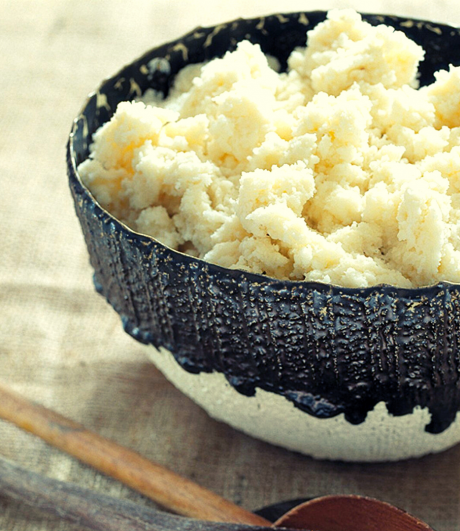
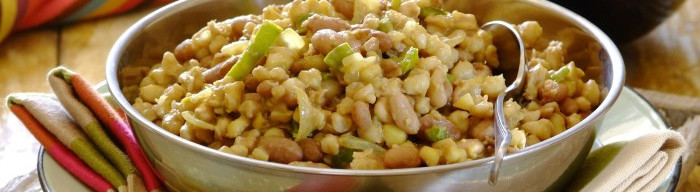
•Umngqusho, a dish made from white maize and sugar beans, a staple food for the Xhosa people.
•Umphokoqo, crumble pap
•Umqombothi, a type of beer made from fermented maize and sorghum.
•Umvubo, sour milk mixed with umphokoqo, commonly eaten by the Xhosa.
•Umbhako, a loaf of bread, commonly made with homemade dough. Normally round, from baking pots
•Umfino, Wild Spinach/Cabbage called imifino, spinach mixed with mealie meal.
•Umqa, a dish made of pumpkin and mielie meal (maize meal)
•Umxoxozi, a pumpkin that is cooked before it is fully ripened.


TRADITIONAL WEAR
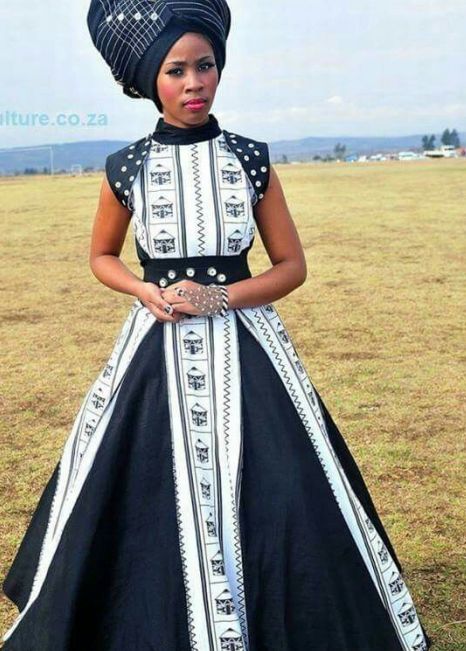
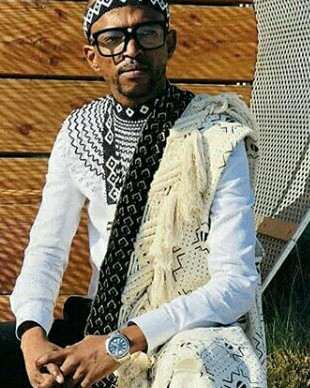
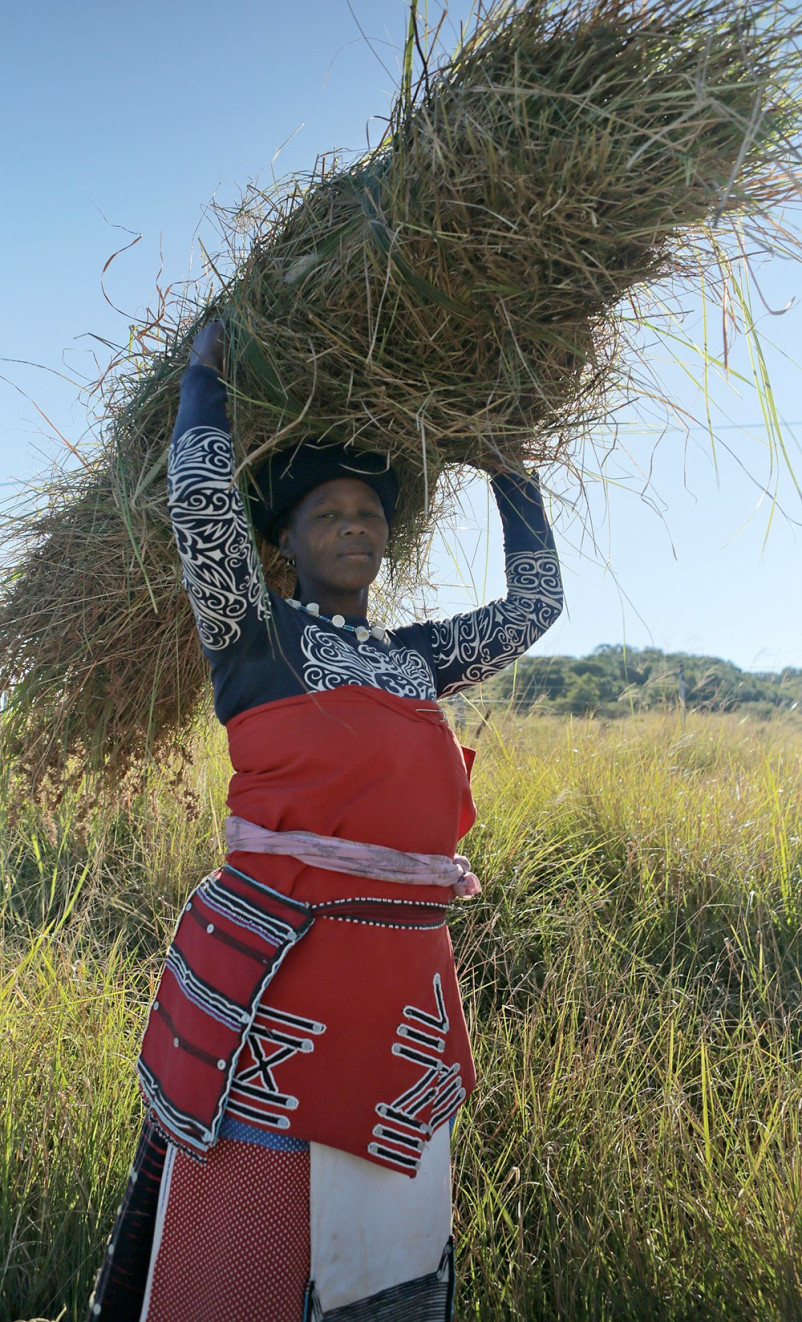
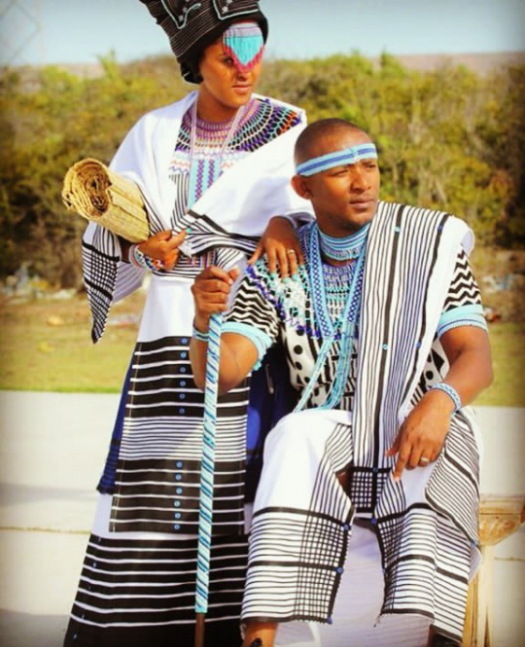
The Xhosa culture has a traditional dress code informed by the individuals social standing portraying different stages of life. The 'red blanket people' (Xhosa people) have a custom of wearing red blankets dyed with red ochre, the intensity of the colour varying from tribe to tribe. Other clothing includes beadwork and printed fabrics. Although in general, Xhosa lifestyle has been adapted to Western traditions, the Xhosa people still wear traditional attire for special cultural activities. The various tribes have their own variations of traditional dress which includes the colour of their garments and beadwork. This allows for different Xhosa groups to be able to be distinguishable from one another due to their different styles of dress. The Gcaleka women, for instance, encase their arms and legs in beads and brass bangles and some also wear neck beads.
Women
Unmarried women often wear wraps tied around their shoulders, leaving their breasts exposed. Engaged women redden their plaited hair and let it screen their eyes, this was done as a sign of respect for their fiancés. Xhosa women wear some form of headdress to cover their heads as a sign of respect to the head of the family which is either their father or husband. Elderly Xhosa women are allowed to wear more elaborate headpieces because of their seniority.
Description
•Incebetha is a small blanket that is used as a bra. It is pinned or adorned with beads. The process of making 'incebetha' is called 'uRhaswa'.
•'Ifulu' is a garment that is worn underneath, below the belt. 'Ifulu' is covered by the 'isikhakha' or 'umbhaco' and is made of a blanket. It is also adorned with beads through 'urhaswa'.
•'Iqhiya' is a cloth that is fitted to the head and covered with beads. Women then wear a small and light weight blanket on the waist called 'uxakatha'.
•Women make bracelets with beads, called 'intsimbi' or 'amaso', which they wear on their feet. 'Intsimbi' or 'amaso' is also worn around the waist. 'Intsimbi' or 'amaso' is made with small wires or flexible material. 'Imitsheke' is worn on the wrist. A small hand bag is worn called 'ingxowa
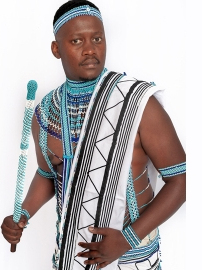
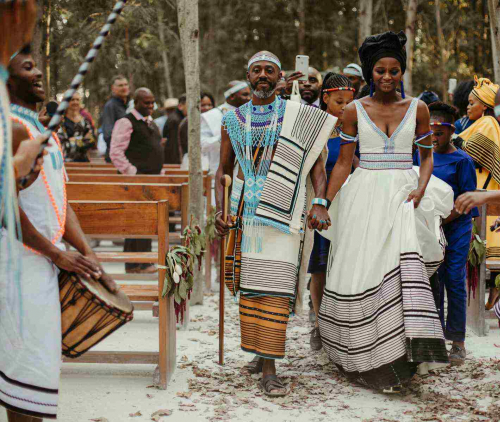
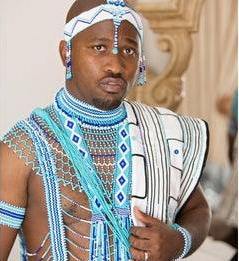
Xhosa men traditionally filled the roles as hunters, warriors and stockman therefore, animal skin forms an important part of their traditional wear. Men often wear goatskin bags in which to carry essentials such as tobacco and a knife. The bag is usually made from skin that had been removed in one piece, cured without removing the hair, and turned inside out. On special occasions such as weddings or initiation ceremonies, Xhosa men wear embroidered skirts with a rectangular cloth over the left shoulder alternatively, a tunic and strands of beaded necklaces can be worn.
Description
Men wear 'ingcawa' a white and black blanket, adorned with 'ukurhaswa'. Men wear beads around their neck. 'Isichebe' is a short bead while 'Isidanga' is a long bead necklace with different colors. Men wear beads around their wrists and foot called 'amaso'. Beads that are worn on the head are called 'unngqa' or 'igwala'. Men smoke pipes that are decorated by 'ukurhaswa'. The traditional smoking pipes are called 'umbheka phesheya'
XHOSA TRADITIONAL WEDDING
Rituals surrounding umtshato (Xhosa marriage)
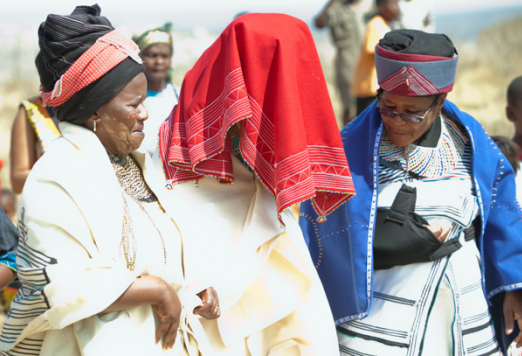
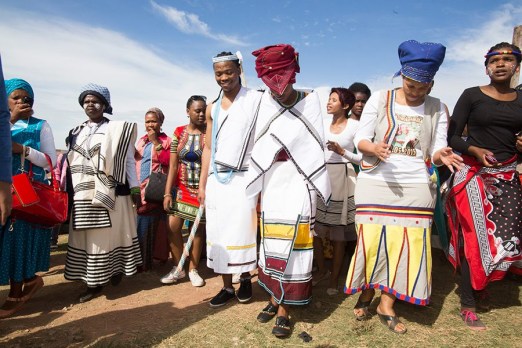
Xhosa marriage, umtshato, is one that is filled with a number of customs and rituals which relate to the upkeep of Xhosa traditional practices. These rituals have been practiced for decades by the Xhosa people and have been incorporated into modern day Xhosa marriages as well. The purpose of the practices is to bring together two different families and to give guidance to the newly wed couple throughout.
Ukuthwalwa
To start off the procedures the male intending to marry goes through Ukuthwalwa which entails him choosing his future bride and making his intentions of marriage known, how ever this practice was not done by all the tribes within the xhosa people.In modern day, the man and woman would most likely have been in courtship or a relationship prior to Ukuthwalwa. Decades before Ukuthwalwa would entail legal bridal abduction, where the man could choose a woman of his liking to be his bride and go into negotiations with the family of the bride without her knowledge or consent. She would have to abide to the marriage as per tradition.
Isiduko
Following Ukuthwala, the man will then be in discussion with his parents or relatives to inform them of his choice in bride. During this discussion the clan name, isiduko, of the woman would be revealed and researched. If it were found that the woman and the man share the same clan name they would not be allowed to proceed with the marriage as it is said that people with the same clan name are of the same relation and cannot be wed.
Ikhazi
Once discussions with the family are complete and satisfactory information about the woman is acquired then the family of the man will proceed to appoint marriage negotiators. It is these very negotiators that will travel to the family of the woman to make known the man and his intentions. Once the negotiators reach the family of the woman they will be kept in the kraal, inkundla, of the woman's family. If the family does not possess a kraal they will simply be kept outside the household as they will not be allowed to enter the household without the acknowledgment and acceptance of the woman's family. It is here where the lobola (dowry) negotiations will begin. The family of the woman will give them a bride-price and a date for which they must return to pay that price. The bride-price is dependent on numerous things such as her level of education, the wealth status of her family in comparison to that of the man's family, what the man stands to gain in the marriage and the overall desirability of the woman. The payment of the bride-price could be in either cattle or money depending on the family of the woman. The modern Xhosa families would rather prefer money as most are situated in the urban cities where there would be no space nor permits for livestock.
Upon return of the man's family on the given date, they will pay the bride-price and bring along gifts of offering such as livestock and alcoholic beverages, iswazi, to be drunk by the family of the bride. Once the lobola from the man's negotiators is accepted then they will be considered married by the Xhosa tradition and the celebrations would commence. These include slaughtering of the livestock as a grateful gesture to their ancestors as well as pouring a considerable amount of the alcoholic beverages on the ground of the bride's household to give thanks to their ancestors. The groom's family is then welcomed into the family and traditional beer, Umqombothi, will be prepared for the groom's family as a token of appreciation from the bride's family.
Ukuyalwa
To solidify their unity the family of the bride will head to the groom's household where the elders will address her with regards to how to carry herself and dress appropriately at her newly found household, this is called Ukuyalwa.Furthermore, a new name will also be given to her by the women of the groom's family and this name signifies the bond of the two families

-ts1635919791.jpg?ts=1721955661)
XHOSA BEADWORK
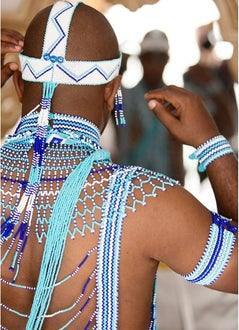
Adornments serve a particular purpose across different cultures as social markers. They are used to ascertain where one belongs to with regards to identity, history and geographical location. They reveal personal information with regards to age and gender and social class as some beads were meant to be worn by royalty. Beadwork creates a sense of belonging and cultural identity and traditions hence people draw their cultural ways of living and meanings, as Xhosa people use them as social markers. Xhosa people believe that the beads also create a link between the living and the ancestors as diviners use them during rituals. Thus beads have some spiritual significance.
Social identities/markers with regards to age, gender, grade, marital status, social rank or role and the spiritual state can be ascertained through Xhosa beadwork. Symbolic references are drawn from the beads through the colour, pattern, formation and motifs. However, it ought to be taken into cognisance that some of these messages are limited to a certain group or between two people. In Xhosa culture beads represent the organizational framework of the people and the rites of passage that people have gone through as the beads are representative of the stages of one's life. Motifs on the beads often used include trees, diamonds, quadrangles, chevrons, triangles, circles, parallel lines that form a pattern that is exclusive to certain age groups. Although the beadwork has some cultural significance with certain motifs having exclusive meanings, the creator of the beadwork has creative control and can create and draw meaning from individual preference. Thus the meanings drawn from the beadwork are not rigidly set.
Among the Thembu (a tribe in the Eastern Cape often erroneously referred to be a Xhosa tribe), after circumcision, the men wore, and still wear, skirts, turbans and a wide bead collar.
A waistcoat, long necklaces, throat bands, armbands, leggings and belts are part of his regalia. The dominant colours in the beadwork are white and navy blue, with some yellow and green beads symbolising fertility and a new life, respectively. Xhosa people regard white as the colour of purity and mediation; white beads are still used as offerings to spirits or to the creator. Amagqirha/diviners use white beads when communicating with the ancestors . These diviners also carry with them beaded spears, which are associated with the ancestors that inspire the diviner; beaded horns; and calabashes, to hold medicinal products or snuff. "Amageza", a veil made of beads, is also part of their regalia, they use these beads by swaying them in someone's eyes so as to induce a trance-like state.
Inkciyo is a beaded skirt that serves as a garment covering the pubic area. Among the Pondo people (Xhosa clan) the beads are turquoise and white in colour. This skirt is worn during a virginity testing ceremony among Xhosa people undergoing their rites of passage into womanhood.
Impempe is a whistle that has a necklace on it. The whistle symbolises one's introduction to adolescence.
Xhosa beadwork and other cultural beadworks have cultural ties, but nowadays beads are also worn as fashion pieces, too, either as cultural appreciation or appropriation. The use of cultural beadworks as fashion pieces means that anyone can wear these pieces without having to belong to that cultural group.

XHOSA TRADITIONAL DANCE
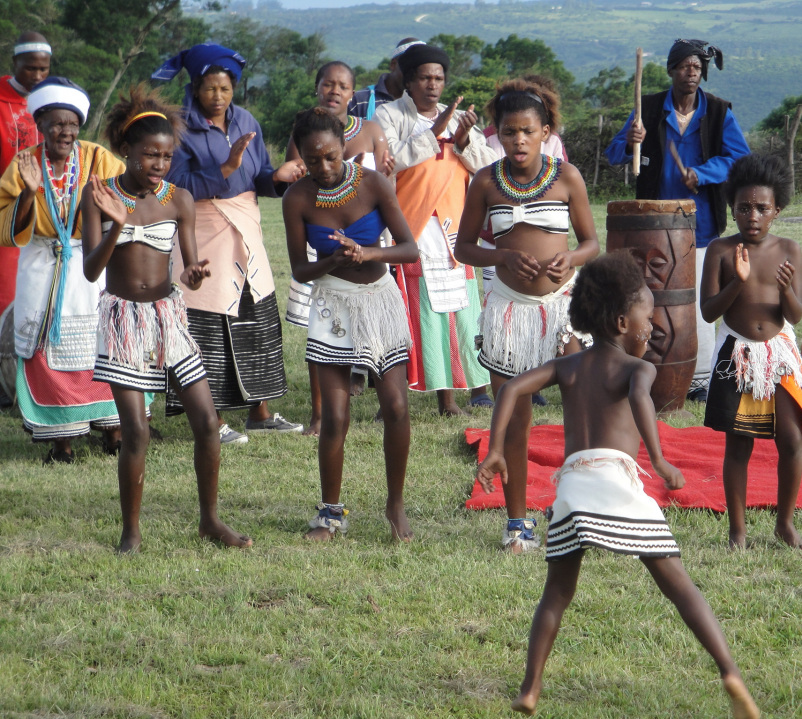
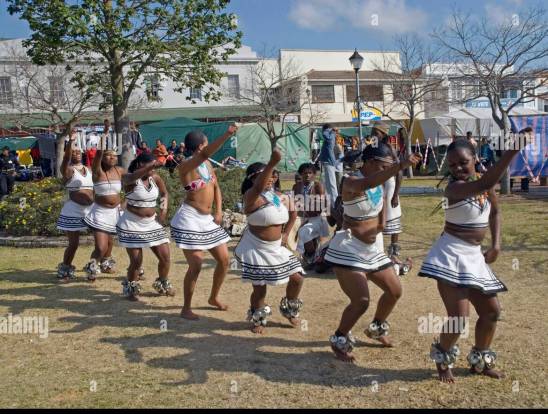
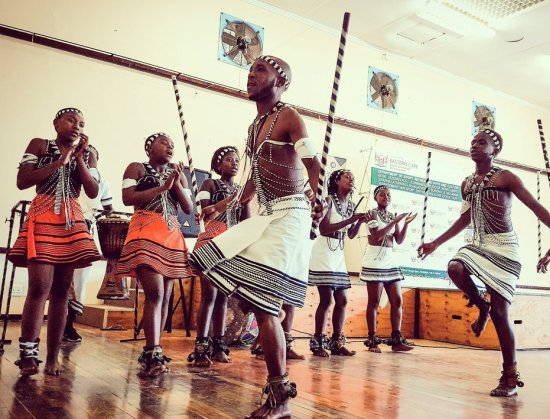
Umxhentso is the traditional dancing of Xhosa people performed mostly by Amagqirha, the traditional healers/Sangoma. Ukuxhentsa-Dancing has always been a source of pride to the Xhosas as they use this type of dancing in their ceremonies.
This dancing includes overt shoulder movements that include shaking the thoracic and the rest of the upper body, stomping barefoot. Umxhentso is usually accompanied by a drum beat or slow vocal music called ukhombela with clapping to give the dancers a rhythm to follow.
Characteristics
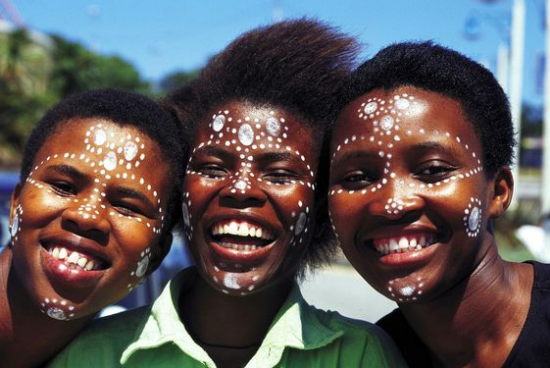
Xhosa people wear beaded clothes when they perform umxhentso the name of these traditional garment is called umbhaco. They usually paint themselves prior to performing. Umxhentso is mostly performed in the Transkei homeland in the Eastern Cape Province of South Africa where the tradition is still valued.
Musical accompaniment includes :
•Uhadi musical bow
•Drum Beat
•Composition and singing of theme songs called ukombela
•A whistle-Impempe made out of Ingcongolo reed
Categories[edit]
The different types of Umxhentso are:
Umngqungqo
An ancient dance performed by old women. It is performed in ritual ceremonies. It requires little movement and is considered to be highly dignified. It is slow and accompanied by low-pitched music and clapping. The umgqungqo is performed on wedding ceremonies, when a young girl is matured normally after puberty or in her teens Xhosa people used to have arranged marriages called 'ukuthwalwa' then on wedding ceremony called 'umendiso' theme songs are sung.
Umdudo
This is a dance that is performed in weddings. The word Umdudo is derived from the verb ukudada which means to swim. The choreography of this dance includes spinning up and down. This type of dancing is often accompanied by ‘umbholorho’, songs performed at weddings(Umtshato
Intlombe
Intlombe is performed by traditional healers/Amagqira during their initiation ceremonies. The term Ukuxhentsa (verb) represents a dance performed by young girls during festivals and traditional ceremonies.
Umguyo
This is a symbol of transition from boyhood to manhood.
